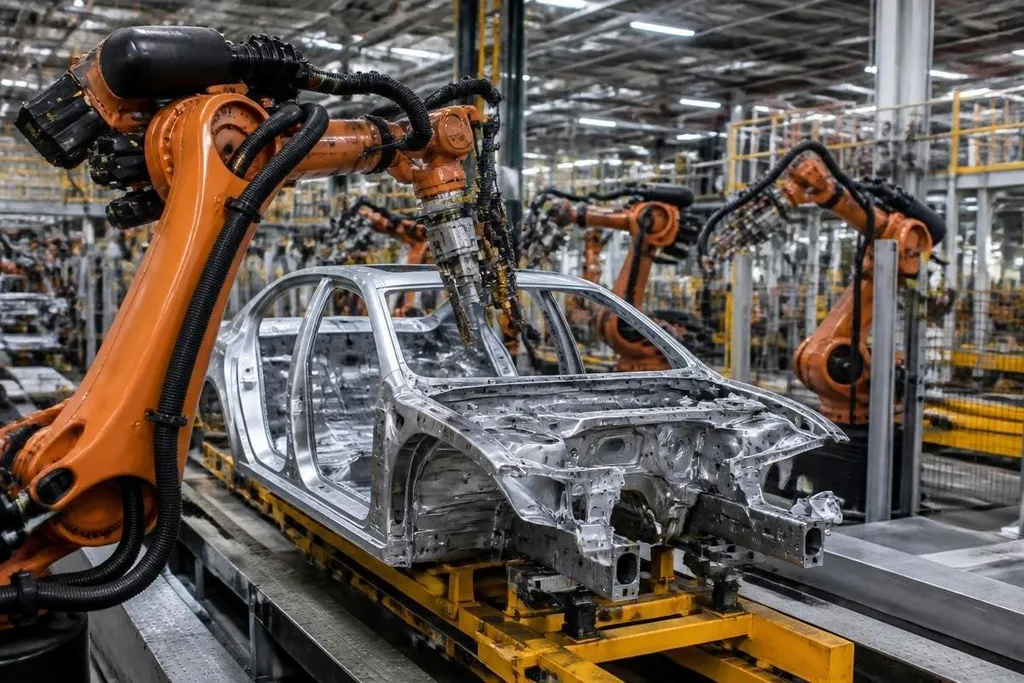
Automotive factories already use robots for welding, painting, lifting, and part movement. The harder task is making those systems useful across changing jobs, mixed parts, and shifts that cannot stop for long setup work.
The global race is moving toward robots that can handle more tasks with less human adjustment. A better robot earns that label through measured work, not a polished demonstration.
Quick read
- The useful measure is finished work per shift, not how human-like the robot looks.
- Vision, grippers, software, and safety controls must work together at the factory floor.
- A system still needs clear limits, service plans, and proof from the job it will run.
What “better” means on a factory floor
An automotive robot may weld a body panel, place a battery module, inspect a surface, or move parts between stations. Each job tests a different mix of reach, payload, repeatability, speed, and safety.
Repeatability means the robot returns to nearly the same position each time. That matters when a welding tool must meet a joint within a small tolerance, or when a camera needs the same view of every part.
Speed alone tells you little. A fast arm that stops often, needs frequent calibration, or struggles with part changes can finish less work than a slower system that runs through the full shift.
The useful measure is the complete task cycle. That includes picking the part, checking its position, doing the work, placing it, and waiting for the next part.
The hard problems behind automotive automation
Parts rarely arrive in perfect positions. A vision system must find the part, estimate its pose, and send that information to the robot before the arm moves. A gripper then needs enough force to hold the part without bending, scratching, or dropping it.
Battery production adds another concern. Cells and modules can be heavy, fragile, and costly to damage. A robot working there needs controlled motion, accurate force sensing, and safety rules that stop the arm when a person enters the work area.
Software links the robot to conveyors, tools, cameras, and factory control systems. If one link fails, the arm may wait even when its own motors and sensors work correctly. That is why a buyer should ask for failure data from the full station, not only the robot arm.
Robot makers also face a choice between fixed automation and systems that can change jobs. Fixed equipment can work well when the same part runs for years.
A flexible system may help when a plant builds several vehicle models, but its setup time and error rate decide if the added flexibility pays for itself.
For an automotive buyer, automotive robotics reports from Robot24.com give the machine, plant, task, and test date behind a claim. That record lets you ask whether the result came from a live production cell or a short demo.
The evidence buyers should ask for
A factory team needs proof tied to its own line. A video of a robot sorting parts says little about how it will handle oily components, poor lighting, tight spaces, or a new tool.
Ask for the full task conditions. The payload should include the tool and any gripper, not only the part. The cycle time should include pauses and checks. The uptime figure should state how the maker measured it and what counted as a stop.
Safety evidence also needs detail. Ask which sensors stop the robot, how quickly the system stops, and what happens after a restart. A safe design is part of production planning because repeated safety stops can reduce output.
A practical buying checklist
Use these points before comparing systems:
- Name the task: Write down the part, tool, reach, payload, and handoff point.
- Measure the full cycle: Include picking, inspection, motion, placement, and recovery from errors.
- Test bad inputs: Run parts that are turned, shifted, dirty, damaged, or partly hidden.
- Check changeovers: Record the time needed to switch tools, parts, and software settings.
- Price service: Include spare parts, training, remote support, and planned maintenance.
- Set a stop rule: Define the failure rate and downtime limit that would end the trial.
I'd judge an automotive robot by the work it completes after the demo crew leaves. That means repeatable cycles, safe recovery, and service data tied to the exact station.
The next stage of this race will be decided by factory records: completed cycles, stoppage time, changeover minutes, and the cost of keeping each station running.